
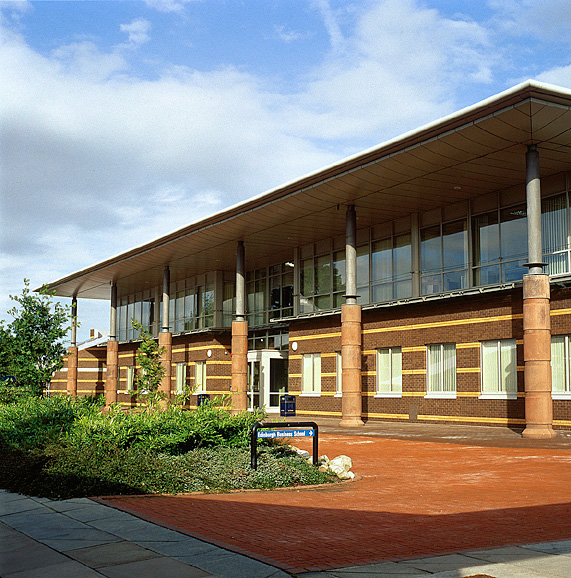
Edinburgh Business School: the origins
October 2026 sees the 30th anniversary of CAPDM Limited, the team that formed to design and build the Edinburgh Business School’s distance learning MBA. All the members had been at EBS for a number of years beforehand but the formation of CAPDM was intended to keep what was a very talented and valuable team together. All these years on the key members are still there.
The EBS MBA was – and still is – a massive success. It was the business idea of Prof. Keith Lumsden who saw the potential to move from teaching a class of 20 to teaching 20,000 globally by explicitly developing ‘distance learning’ content allowing students to learn in their own time, at their own place and fitting into their individual circumstances. The idea was bold, completely anathema to the university (Heriot-Watt) and radical in its focus on the individual, not the institution.
Prof. Lumsden had the idea, but it had to be designed and built. I had that responsibility, but I needed a core team to do it. At that time we weren’t blinded by the technology, though we were all experienced software and information engineers. The focus was on the learning content and the value that the underlying intellectual property had. ‘CAPDM’ (Capture, Author, Publish, Deliver, Manage) was our guiding philosophy as we viewed the task of building the MBA as an exercise in information management and delivery. 30+ years on, online learning has seemingly become more about the technology and tools than the learning content.
EBS itself became an authoring house for the large volumes of content that students would learn from – every student receiving ALL content, irrespective of location and circumstances. CAPDM became the publisher for EBS. It was at a scale not seem before and probably not since. It comprised some 4,400 study hours (in English, Spanish, Chinese and Arabic) and 800 different deliverables for 37 released courses in print and online, all from 20 million words, 8,000 vector diagrams and images, and sundry other media objects. Try building that by hand in your favourite LMS today.
Information standards and a digital strategy
The value of the IP was enormous, so we cherished it. All content was captured in ISO 12083 (Book Standard) SGML and stored in a single master source, revision controlled, digital database. Many wondered why we chose to do that, but the intention was to separate the management of the content from how it was delivered. CAPDM still takes this approach to this day, though nowadays we use XML and most often the DocBook standard. The content was captured, managed and revised before being published and packaged for delivery. Initially delivery was to print-ready PDF for printing, though this was to quickly change.
Publishing from the SGML was not particularly easy. The CAPDM team had to write a publishing suite to enable this – an activity that continues to this day with their very efficient ‘CourseWorker’ suite. Of course, people were quick to point out that we could have used PageMaker or similar at that time, but they completely missed the point. Locking into a particular technology is a rather obvious mistake, though many online learning teams still choose to take this approach to this day.
The EBS MBA launched – on paper – in 1991 and is still going strong to this day. However, in 1992 we saw the World Wide Web for the first time. This was one of a number of interlinked, public information systems being developed at that time, including other contenders such as HyperG, WAIS and Gopher, all of which we were able to publish to from our single master sources.
The move to online
The WWW was particularly suitable for us to deliver to as it was basically built on a simple instance of SGML (read XML today), i.e. HTML. It was a simple enough task for us to write the code to publish to the WWW, giving us an internal, prototype online delivery in 1992. After refining our publishing capabilities, EBS launched a full online MBA programme in 1994 though it took a couple of years before there was an appreciable market. However, the MBA grew very quickly. It was obviously the first such online programme in the UK and probably globally, but it also had all the characteristics that the market was looking for, particularly flexibility. The MBA was complete, identical in content across the web, the paper-based version and the on-campus programme, and the online version quickly became the only delivery version.
CAPDM’s publishing was very scalable and repeatable, extremely efficient and very low cost, and so the online version dramatically cut production and other costs. This efficiency and cost base is a key feature of CAPDM’s offering to this day.
CAPDM managed the translation of the MBA materials into Chinese, Spanish and Arabic, in doing so ensuring that the translators preserved the SGML/XML structure. Our publishing suite was then able to publish these language versions as before. And it was not all about the text. All vector diagrams (of which there were many) were drawn with a common graphic layer, but with separate language layers to be output in many formats: GIF (for the web) and EPS (for PDF output) and in each of the four languages. Developing a significant online programme at the scale and complexity of the MBA begins to explain why CAPDM required what many saw as a heavy-handed digital strategy, but we remain convinced that this is exactly how such developments should be approached. The UK Open University develop at an even bigger scale and they manage this with a very similar approach.
Aside from the development of the actual courses, CAPDM also had to actually write the original LMS/VLE system to run the MBA. There were no off the shelf packages at that time. That original system would still look good against Canvas, Blackboard, etc to this day, which is perhaps an indictment on how restrictive and unimaginative these systems still are.
On a similar note, we also had to write the complete administrative system required to support student-focussed, distance learning at Heriot-Watt University. This was a very significant system, required because the needs of flexible, non-timetabled learners was completely out of the capabilities of the admin systems that existed at that time. I suspect that it is true in many or most institutions to this day.
The learning curve
The EBS MBA was the perfect environment for CAPDM to learn about online learning in its entirety, as we owned the whole process. This paper details the A-Z of our journey, from a business and education model, to one of production and operation, and is a valuable insight for others in this business. It’s not just about building a course in Canvas, Blackboard or whatever. Over the years we have heard many a learning developer tell us that they can build ‘better’ courses using the various tools on hand at the time, but this is only a small part of the whole business of moving to, or adopting, an online model of education: the reality of sustaining an educationally sound and financially viable business in online learning involves so much more.
After EBS
EBS was where we started and where learned our trade. Since then CAPDM has developed significant courses and programmes for a number of universities, professional institutions and businesses. For example, we worked with Cardean University/Unext to help build the first online MBA in the US (and there is a wonderful story behind that!). We built the first online programme at Edinburgh University, a programme in Sports Science delivered in conjunction with the University of Queensland. CAPDM helped the University of London Worldwide make the transition from distance learning to online learning with their ‘Track C’ design, before going on to build the very successful MPAcc from UCL and Global MBA from Queen Mary.
There have been many others, but all have followed the same strategy:
- master in an information standard (e.g. DocBook XML);
- deliver to a variety of formats (e.g. HTML, PDF, ePub3);
- package for target delivery environments (e.g. Moodle).
In our 30 years of our existence the technologies have changed often and radically. The way we manage information in a technology agnostic way has not. As the technology changes, so too do the ‘P’ and ‘D’ steps of our CAPDM model and our publishing suite, allowing us to fully exploit the capabilities and functionality of the delivery environments.
We follow the words of George Washington who once said: “If I had six hours to cut down a tree, I’d spend four hours sharpening the axe.” Our ‘four hours worth’ is spent adapting our publishing tools. In contrast there are stories of how institutions have spent inordinate amounts of time simply to convert – by hand – their courses from one version of a learning environment to the next.
When I look back over these 30 years, I have to suggest that few institutions are producing courses as good as we were able to do back in our EBS days, and none (with the exception of the OU) have the scalability and repeatability that we had or, crucially, the cost base that our approach operated at. I wonder what the next 30 years will bring.